The Night I Realized I Was the Maid, Not the Mom
The one selfish rule that saved my evenings, and helped my kids.
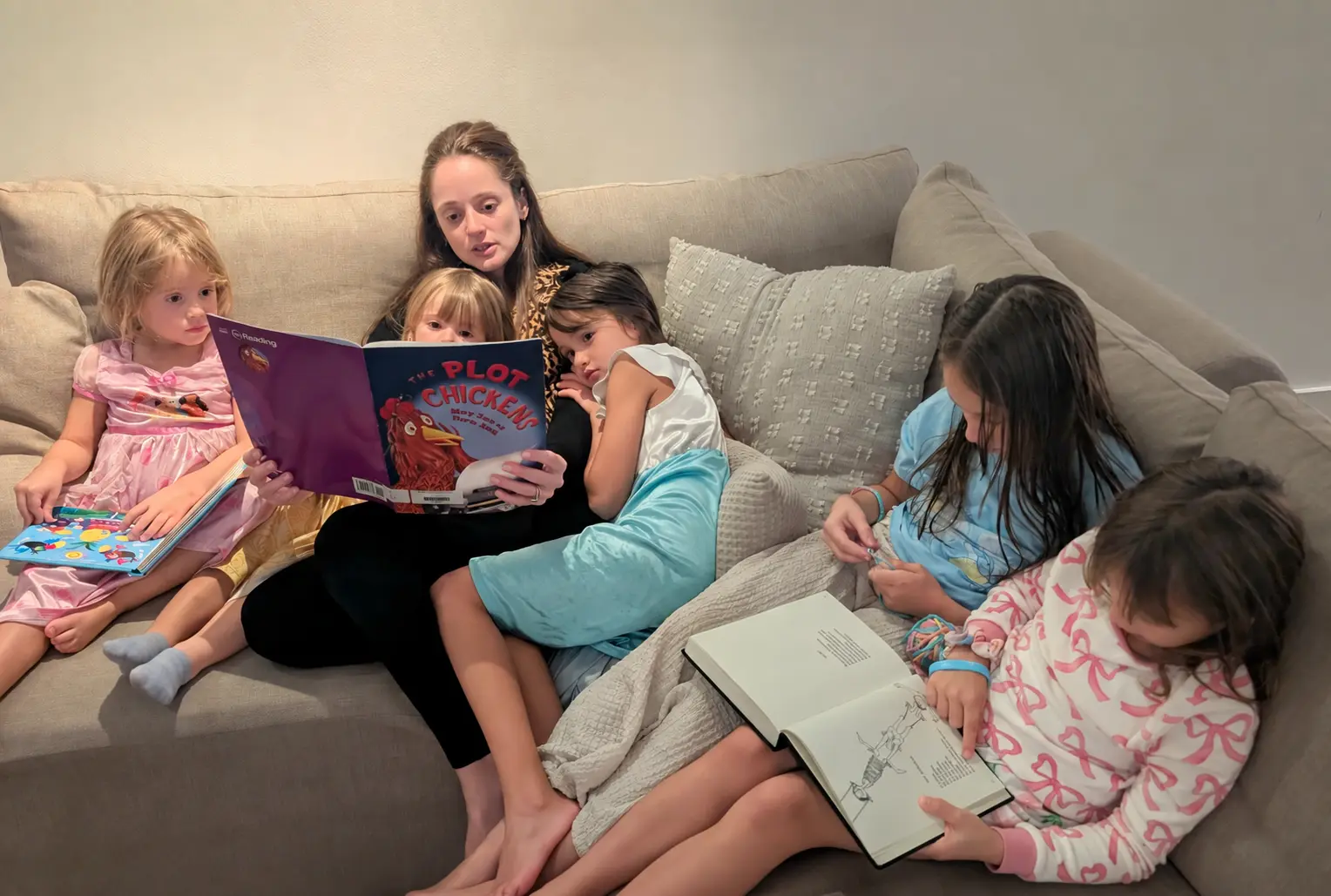
You know that stretch of the evening you actually wait for all day?
Dinner is done, the dishes are handled, the little ones are out of the bath. Somebody hands you a book. Somebody else climbs into your lap without asking, the way they do when they’re still small enough to think your lap belongs to them.
All you want is to read to them and soak in the snuggles.
That twenty minutes is the whole reason you got through the rest of it.
And then a kid appears in the doorway and says, “Mom, I’m hungry.”
So the lights go back on. Out comes the cutting board. You are slicing apples at 7:30 at night for a child who left half her dinner on her plate an hour ago, and you can hear the reading happening in the other room without you. Then somebody else hears the fridge open and now there are negotiations, and by the time the counter is wiped down a second time, everyone is overtired, bedtime has slid another twenty minutes, and the part of the night you were looking forward to is just gone.
Not ruined. Just gone. Which is somehow worse, because there’s nothing to be upset about.
This was most nights in our house.
The night it finally broke
Peter was in the other room reading to half our kids.
He told me later what he was thinking while he read. Another night with only half the family here.
So he got up to find me.
There I was at the sink, washing the same dishes I’d already washed, with two of our girls at the counter working through apple slices and a banana. I looked up at him and said the thing I’d been saying for months.
“I just wanted to snuggle.”
And he said, “Then close the kitchen.”
I must have looked at him like he’d suggested we sell the house.
“They ate dinner,” he said. “They had dessert. Nobody in this kitchen is starving. And if they were actually hungry, they’d have finished their plates.”
He was right. I knew he was right the second he said it, which is the most annoying way to be right.
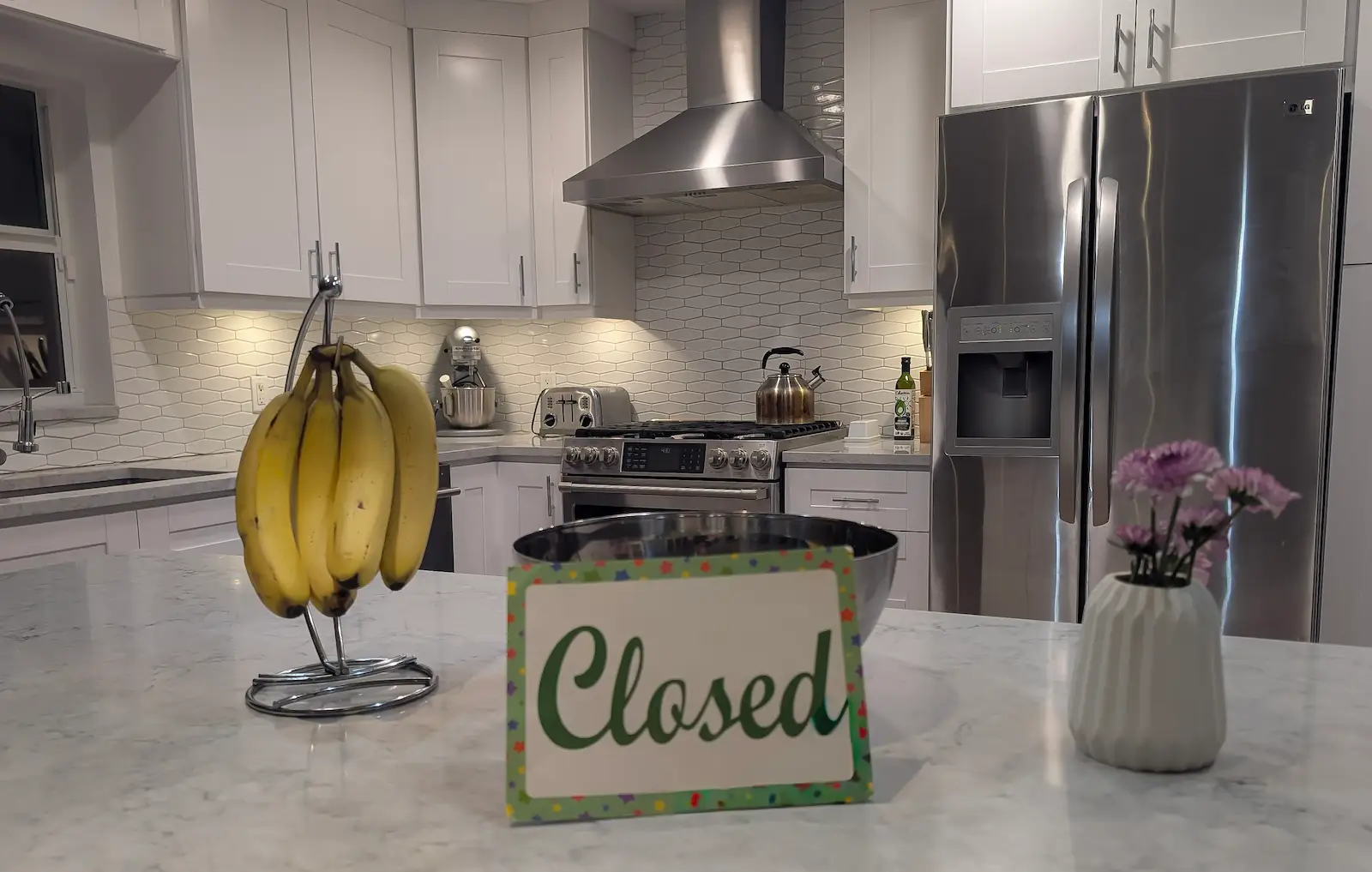
“Starting tomorrow,” I told him, “the kitchen closes at seven.”
Not a noble rule
I want to be honest about the motivation here.
I did not close my kitchen because of some carefully reasoned health philosophy. I closed it because I was tired of cleaning it twice and I wanted my twenty minutes of snuggles back.
The rule is simple. After dinner, the kitchen is closed. Not closed unless you’re really hungry. Not closed but I’ll make an exception tonight because it’s been a day. Closed.
There was pushback the first week. Of course there was. By week three nobody asked anymore, which tells you something about how much of that hunger was actually hunger.
Then other things started changing
Here’s the part I didn’t see coming.
My kids started finishing their dinner. When a snack an hour later stops being an option, dinner stops being optional too. The plate in front of you is the plan, and suddenly the broccoli situation resolves itself without a single conversation about the broccoli.
The evenings got softer. Nobody is standing at the counter with a paring knife while everyone else is halfway through a chapter. We stay in one room. I’m actually in the story instead of listening to it from the sink.
And I stopped doing a second cleanup, which was the entire point and is still my favorite part.
Then there was a fourth thing, and this one is my whole profession.
I knew the science cold. I just hadn’t applied it to my own kitchen, because at 7:30 at night I’m not a dentist. I’m a tired mom holding a paring knife.
I’ll come back to that one.
A conversation I have almost every day
A mom sat down in my office recently with her daughter.
She was expecting a clean checkup and she had every reason to. Her daughter brushes twice a day, and she checks. They’ve never missed a six month visit. They eat real food, organic when she can find it, and there has never been a soda in that house.
And her daughter had cavities.
She looked at me and said the thing almost every mom in that chair says. “I don’t understand. We do everything right.”
So I asked her a question that has nothing to do with brushing.
“When does she eat?”
She started listing it out. Breakfast. Something in the car. A snack after school. Then something while she’s doing homework, because she’s growing. Fruit while I’m cooking, because she’s hovering. Dinner. A little something before bed.
Then she stopped in the middle of her own sentence.
“She’s basically eating all day.”
Yes. And every single thing on that list was healthy. That’s what she couldn’t get past. She’d done the hard part. She cut the junk years ago, she reads labels in the grocery store, she is the reason that house runs the way it does.
The food was never the problem. The clock was.
What’s actually happening in there
Here’s the part most of us were never taught.
Sugar doesn’t cause cavities.
I know how that sounds coming from a dentist. Stay with me.
The bacteria in your mouth eat the sugars and carbohydrates you eat, and as they digest them they produce acid. It’s the acid that dissolves enamel. Not the food.
And your body already has a fix for this. Saliva neutralizes the acid, washes it away, and carries minerals back into the enamel. Your teeth repair themselves every day, for free, while you’re not paying attention.
But it takes time. Every time you eat, the acid goes to work within minutes, and your saliva needs somewhere between twenty minutes and an hour to undo it.
So one snack is fine. Your mouth handles it easily.
But when the next snack arrives before saliva has finished the job, the clock starts over. The acid never clears. And a mouth that spends most of its waking hours in the acid zone never gets its turn at the repair work.
Which is why the research keeps pointing at frequency rather than quantity.
CAMBRA is the caries risk assessment most functional dentists use, and it runs the same for every age. It flags one habit as a risk factor: snacking on fermentable carbohydrates three or more times a day outside of mealtimes.
Read that again. Not sugar. Fermentable carbohydrates. Crackers, pretzels, dry cereal, a granola bar, the crust off your kid’s sandwich. And not three meals. Three times outside of them.
That’s fruit after school, a handful of something while you’re cooking, and a little bite before bed. Or a coffee you nurse from nine until noon, almonds at your desk, dark chocolate after dinner.
One of those is a child’s day. One is yours. The chemistry can’t tell them apart.
Six clean, organic, whole food snacks scattered across a day can be harder on enamel than one cookie eaten at the end of lunch.
And before you decide this is a kid problem
None of that changes with age. Same bacteria, same acid, same twenty minute clock.
But two things make it worse for you than for them.
Your kids get a second set of teeth. You don’t.
Every millimeter of enamel you have is what you were issued, and it doesn’t grow back. The grazing pattern that costs a fourteen year old a filling costs you a crown.
And saliva, the entire defense system in this story, gets quieter with a long list of ordinary medications. Antihistamines. Antidepressants. Blood pressure medication.
So picture the version I see in my chair constantly. A woman in her forties, allergy medication every morning, coffee she nurses from nine until noon, almonds at her desk, a wellness bar in the afternoon, a piece of dark chocolate after dinner.
Nothing on that list is junk, but every single one restarts the clock, and she has less saliva to reset it with than she did at twenty five.
That’s not a hygiene problem. She could brush six times a day and still lose ground.
The part I didn’t plan
So back to that fourth thing.
I have been telling parents to space out eating windows for as long as I’ve been practicing functional dentistry. It’s one of the first things I go through with a family. Fewer acid hits, longer recovery gaps, let saliva do the work it’s built to do.
And then one night my husband told me to close the kitchen, and I said yes because I wanted twenty minutes on the couch.
It took me until well after the rule was in place to look at my own evenings and realize what I’d actually done. Closing the kitchen after dinner hands my kids a long, uninterrupted stretch of recovery time right before bed, which happens to be exactly when saliva production drops off for the night. Fewer eating windows. Longer gaps between them. More hours doing repair work instead of damage control.
It’s the same advice I give in my office every week. I just arrived at it from the sink instead of the operatory.
I closed the kitchen for the dishes. Their enamel came along for the ride.
If you want to try it
Summer is when snacking is at its worst, because the kitchen is open from breakfast until bedtime and nobody is really keeping track. The school year is the natural moment to reset it, since meals are already spaced out during the day. You’re really only rebuilding the afternoon and the evening.
Here’s what works in our house.
- Set a closing time and mean it.Ours is seven o’clock. A rule with exceptions isn’t a rule, it’s an opening bid, and children are extraordinary negotiators.
- Cluster instead of scatter.One real afternoon snack beats grazing from three o’clock to six. Same food, a fraction of the acid.
- Water stays open.Water doesn’t restart the clock. It helps.
- Expect one rough week.Then it stops being a rule and just becomes how your house works.
What you get back is less cleanup, kids who eat their dinner, an evening that stays in one piece and you get your twenty minutes of snuggles.
The teeth are a bonus.


